Monday, March 30, 2015

When Crackers Won't Cut It: Carnivory in Parrots

Animals do surprising things, and this should come as no surprise. After all, they are more than just entries in field guides; they are living beings and individuals which react different to a variety of unique situations. Most animals are both intelligent and intuitive, and will change their behavior to better survive an unlikely situation, or take advantage of situations which they find favorable.

As evolution is driven at its core by the need to gain resources for survival and reproduce, it makes sense that many surprising behaviors are related to food and sex. I’d like to address the former rather than the latter, and you can busy yourselves by searching for articles on the subject. Trust me, there’s enough material on strange animal sex to give you nightmares.

Sometimes, animals eat things that we don’t expect them to. Lions, jaguars, and other large carnivores will readily eat fruit when preferred prey is limited. Seals and walruses will chow down on seabirds when on land. Deer and cattle have been seen time and time again chewing on bones and eating young birds to gain essential calcium in their diets. But perhaps one of the most intriguing cases of bizarre gastronomy in animals is the fact that some parrots will eat meat when given the chance.

Granted, this is uncommon, but this is the norm for unexpected behavior. As far as observed instances of carnivory in parrots, I believe that only two species have been readily seen eating other animals/animal products: the kea Nestor notabilis and, just recently, the rainbow lorikeet Trichoglossus moluccanus.

Kea: Scourge of the Kiwi ski slopes
The kea is a weird parrot to begin with - it lives in New Zealand (already a sure-fire sign that it is a strange bird), specifically in the chilly alpine regions of the country, where it can be seen engaging in play behavior such as rolling in the snow and destroying your car. They are also really smart, even for parrots: in the wild and captivity, they have been able to solve manmade puzzles in order to get treats (non-meat, I presume).

A kea, happily removing your windshield wiper for its own amusement. They regularly dismantle manmade objects found in their environment, including cars, tents, and backpacks.

So what does an alpine, cold-weather parrot eat? Like most parrots, most of its diet consists of vegetation, with a few invertebrates thrown in. However, it is also an active predator. In addition to rabbits (don’t feel bad, they’re an exotic invasive in New Zealand and deserve it), kea will also infiltrate the nest burrows of shearwaters and drag out their fat, unfledged chicks. I’d just like to state, at this point, that if you’re still doubting that birds are dinosaurs, it’s not too late to change your mind.

Perhaps the most long-winded and interesting debate over the diet of the kea is whether or not it preys upon sheep. Sheep, as you know, account for most of New Zealand’s population. There have been observations of kea landing on sheep and ripping into their flesh. Yes, really. There’s even an old photo of a sheep supposedly killed by kea, showing tufts of wool around the carcass where the birds attacked. Knowing the kea’s track record for being the most metal and un-parrot-y parrot, I would not be surprised if these sheep attacks are more common than we realize.

Rainbow Lorikeet: The true sparkleraptor
Appparently, at least one person in Australia leaves out meat for endemic carnivorous birds to come and eat. Besides being the most awesome bird feeding system ever, the offerings attract kookaburra and currawongs. But recently, a new bird has taken a liking to the meat, and has even began chasing others away.

Behold the face of a true monster.

A pair of rainbow lorikeets chowing down at the
meat-filled bird feeder in question. Photograph taken by Matt Watson.
Now, I’m still trying to wrap my head around this one, honestly. Lorikeets are largely nectar-eaters, occasionally taking fruit and nuts as well. Some zoos have feeding stations for them, allowing you to walk among them with cups of simulated nectar, which they will swarm around. I think next time I go to one, I’m going to bring a pork chop instead.

What could lorikeets possibly want to do with meat? Why this sudden change in appetite? It’s likely that the meat contains essential vitamins and proteins which are beneficial to the parrots. However, perhaps it is just a matter of preference - in the yard in which this occurred, native flowering and fruiting trees were even more abundant than the meat scraps left out at the feeders. Even if this is an isolated case, I am curious to see what ornithologists make of it - continued observation of this bizarre instance is needed in order to better understand it.

I often like to think of parrots as the primates of the bird world in terms of their social behavior, feeding habits, and adaptability. And, just like chimpanzees, it seems that particular species have a fondness for something other than the usual fruit or nut. Just keep an eye out the next time Polly starts eyeing the family cat.

Thursday, March 26, 2015

Triassic Thursday IV: Giant temnospondyls

By both diversity and popular opinion, reptiles ruled the Triassic. I’ve said it again and again on this blog and I’m sure you’re sick of it. So how about we change things up and talk about big gregarious flat-headed amphibians?

Before I begin, let me clear something up about what we like to call “amphibians.” You mention the word to most people and they will get the general idea of what an amphibian is: a frog or a salamander, for example; something that has moist skin and likes to swim around and lay little squishy eggs. Based on this diagnosis, lots of extinct critters fall into the category of amphibians. The animals I am about to discuss, however, are not the same as the amphibians we’re familiar with. Rather, they are labyrhinthodonts, specifically temnospondyls: members of an extinct clade of large, often crocodile-like amphibians which were among the dominant semi-aquatic predators from the Carboniferous to the early Jurassic. My point, I suppose, is that it is taxonomically incorrect to refer to these big guys as amphibians per se, but they aren’t far off and I won’t judge you for referring to them as such. Whether or not they would take offense remains to be seen.

Across the floodplains of Late Triassic Pangaea, which was slowly drifting apart, huge vernal pools and ponds were home to groups of these large temnospondyls. Metoposaurs and mastodonsauroids were the biggest in the Triassic, growing to a couple of meters long. They also have some ridiculous-looking skulls. The first time I heard someone refer to metoposaurs as “toilet seat-headed,” I was surprised I hadn’t thought of it myself. The resemblance is uncanny. 

Metoposaurus bakeri, a toilet-headed temnospondyl. Reconstruction by DiBgd, from Wikipedia.

These giant toilet-headed beasties probably ate whatever they could fit into their big mouths. Fish were probably key menu items; however, with eyes located dorsally on their skulls and an overall dorsoventrally compressed bodyplan, it was likely that they could ambush riparian animals as well. Living in a time of phytosaurs, rauisuchians, and dinosaurs, I’m sure that temnospondyls were much more often the prey of reptiles than the other way around.

Some of the best-preserved metoposaurs come from mass bone beds. For a while, it was thought that these animals had gathered together during a drought, congregating in rapidly-dissipating pools which were essential for their survival. However, taphonomy of these bone beds suggests that, while they were likely in close association when alive, they were probably carried from other locations rather than being preserved in a single pool. Perhaps these metoposaurs lived as crocodiles do in resource-abundant areas, passively gathering together when times were plentiful. Or, some suggest, they could have gathered to spawn, which would have been an awesome spectacle: imagine a vernal pool on a Pangaea floodplain full of dozens of writhing, spawning, two-meter temnospondyls depositing tens of thousands of eggs. Beautiful. And gross.

Thursday, March 19, 2015

Triassic Thursday III: Carnufex

Fresh off the presses of the Internet, and just in time for a new Triassic Thursday, comes a brand-new crocodylomorph predator from the Late Triassic of North Carolina. On the heels of the armored-necked aetosaur Gorgetosuchus, which hails from the same area, we are graced with Carnufex carolinensis. It was one of the first crocodylomorphs to reach the status of apex predator in this Triassic ecosystem.

The skull of Carnufex. With a long, pointed head, it was very different
from most large predators of the Triassic. From Zanno et al., 2015.

One look at the skull of Carnufex, and you realize that this was not typical of Late Triassic ecosystems: its skull was slender and long, and looks for all the world like the skull of a theropod. It was likely a gracile and slender animal, rather unlike what we see in the majority of crocodylomorphs. Its lightweight frame and long limbs gave it an advantage of agility and speed during a time when most reptiles, barring crocodylomorphs and dinosaurs, were amblers or lumberers.

While I have previously written about the success of pseudosuchians and other crocodile-line archosaurs during the Triassic, Carnufex was truly something exceptional: it is currently the oldest-known crocodylomorph, more closely related to true crocodiles than to rauisuchians and their ilk. As such, it was something novel on the landscape of the Triassic: it was likely more slender and adaptable than other large reptiles of the time. It was the forebear of an age which was as much dominated by crocodylomorphs as it was by dinosaurs.

I highly recommend checking out Zanno et. al's paper (which can be found here). The discovery of Carnufex is a significant one for understanding the evolution of crocodylomorphs, and how they were able to diversify rapidly at the end of the Triassic following the extinction of other lines of pseudosuchians. 

Thursday, March 12, 2015

Triassic Thursday II: Aetosaurs

Aetosaurs, of the family Stagonolepididae, were prominent herbivores during the mid- to Late Triassic. I love aetosaurs: their snouts and prominent body armor made them the ecological equivalent of warthogs covered in spikes. They were a globally-dispersed species, with specimens being found in the Americas, Europe, Asia, and Africa. Before low-browsing dinosaurs evolved, these guys were the herbivorous powerhouses.

The main difference between aetosaur species is the arrangement and shape of body armor. However, most species contain an armadillo-like covering of osteoderms, protecting their neck, back, tail, and stomach from large predators such as the dino-mimicking rauisuchians with which they shared their environment. The most extensively-covered and elaborately-adorned aetosaur of them all was, without a doubt, Desmatosuchus, which I think bears an uncanny resemblance to the nodosaur Sauropelta. Clearly, the big shoulder spine look was not a fad limited to the Triassic.

The spike-shouldered aetosaur Desmatosuchus. Reconstruction by Dr. Jeff Martz.

Most other aetosaurs were not as well-equipped as Desmatosuchus. Most had parallel rows of TV remote-shaped scutes running down their backs. Still, this thick armor was enough to deter some of the biggest predators of the Triassic.

There is some evidence out there that aetosaurs constructed nests. Simple bowl-shaped depressions in the ground found in Arizona may belong to motherly aetosaurs. Archosaurs in general are known for parental care and nest construction, so the fact that these large nests may belong to aetosaurs is entirely within the realm of possibility.

Material from the new aetosaur Gorgetosuchus (Heckert et. al 2015).

Aetosaurs are particularly topical because a brand new species was just identified from North Carolina. Dubbed Gorgetosuchus, it had a ring of osteoderms surrounding its neck, like a huge bony collar. Despite being heavily-armored and generally of the same body shape, the diversity of aetosaurs in the mid- to Late Triassic is pretty incredible considering that the earth was still in recovery. The Triassic was a time of great proliferation, especially of reptiles.

Thursday, March 5, 2015

Triassic Thursday I: An Introduction, and Coelophysis

Because I’m pleased as punch to be making progress on my microfossil research, I hereby declare that, henceforth, Thursdays shall be Triassic Thursdays!

The Triassic period was one of the most bizarre periods in Earth’s history. The world was recovering from the most catastrophic mass extinction which has ever occurred: at the end of the Permian, over 90% of the planet’s species had gone extinct due mass volcanism which was covering basically all of Russia. A strange cast of characters, most of them synapsid amniotes, disappeared in this cataclysm. But the tragic end of the Paleozoic Era was the glorious dawn of a planet dominated by reptiles: the Mesozoic.

The Triassic was just plain awesome, and the fossils prove it. With the planet essentially a giant blank slate, evolution let loose the reigns of predictability and spun a ridiculous world of diapsids. The beginnings of all modern groups of reptiles can all be found in the mid-late Triassic: lizards, turtles, crocodiles, and dinosaurs all had their roots during this time, as well as other reptiles which have left no living descendants, including sauropterygians (ichthyosaurs and their kin), placodonts (which I have previously written about), and pterosaurs, the first flying vertebrates. Also thrown into the mix are reptiles which still puzzle us with their bizarre anatomy: monkey-lizards and their leaf-mimicking relatives, creatures with necks twice the length of their entire bodies, and dragon-like reptilian otters have all been discovered in Triassic localities, and are still contested over where they belong among other reptiles.

How awesome was the Triassic? This awesome. A couple of pseudosuchians (an aetosaur on left and a rauisuchian on right) square off. You can see a small theropod dinosaur in the background, biding his time before his kind throws the largest biological coup in history. Illustration by Julius Csotonyi.

This is why I am happy to be conducting research on the Triassic. I’ve been a paleo-nerd for my entire life, and anyone with a passion for paleo knows how cool the Triassic is. Not everyone agrees that it is the best (but we won’t judge them for that), but in terms of biological and evolutionary significance, it’s easily in the Top 5.

So, what exactly am I doing? Why, I’m glad you asked! So thoughtful, you.

Over the past year, I have been looking through what appears to be dirt and gravel in search of microfossils. These are 1-2mm size chunks and fragments of bone, teeth, scales, and whatever else happens to be fossilized. And there are lots of them! While a sizable chunk of matrix might only contain a couple dozen vertebrate microfossils, it is a challenge to properly identify them, just because of the condition they’re in. Trust me, when all you have of a small animal is a small chunk of a small bone, it gets tricky. But therein lies the fun!

My ultimate goal is to identify specimens of juvenile archosaurs (that is, dinosaurs and crocodylomorphs, which I have also written about) from the samples I and others have collected, and to identify characteristics of these fossils which can be used to identify other juvenile archosaurs from other places and periods. These samples, which are professionally stored in gallon plastic bags, hail from the Hayden Quarry of the Ghost Ranch locality in Abiquiu, New Mexico, which I had the pleasure of visiting and the honor of working with a group of Triassic paleontologists from around the country. 

It’s a bit ambitious, I’ll give you that. A grant reviewer even called this effort too much for a “questionable gain in knowledge.” But hey, I won’t complain. I’ve always wanted to conduct paleontological research and I’m really enjoying it. Plus, I’ve already found some fossils which may fit the criteria I’m looking for. 

Well, now that you know a bit about why I love the Triassic and why I so enjoy this project, let me introduce this week’s Triassic beastie.

Coelophysis bauri


A Coelophysis family about to chow down on an unfortunate drepanosaur. Illustration by Asparavis, from deviantArt.

Coelophysis is one of the best-known dinosaurs, largely due to the enormous quantity of specimens that have been recovered from the American southwest. Hundreds of individuals are known from several quarries in New Mexico and Arizona, and range in age from juveniles to adults. Such abundance is really awesome for paleontologists, as it is so rare to have even one individual of one species preserve in the fossil record. Coelophysis provides a unique opportunity for studies of ontogeny, or growth, from a young to mature animal. 

Like most dinosaurs of its day, Coelophysis was no heavyweight. Only a couple of meters long, it was dwarfed by an array of crocodile-line predators. However, its descendants were some of the largest predators of the Early Jurassic, soon after the crocodilian competition had gone extinct at the end of the Triassic. It probably hunted insects and small reptiles. In fact, it is one of the dinosaurs known to be preserved with stomach contents. 

Coelophysis stomach contents (in yellow). From Nesbitt et al. 2006.

It was thought for a while that this Coelophysis was a cannibal which had eaten a younger member of its species. However, it was found that the bones preserved in this guy’s torso did not belong to Coelophysis, but an early crocodylomorph. 

Coelophysis was a gracile animal with birdlike bones, a trait which is reflected in its name, which means “hollow form.” It is a classic example of the anatomical advantages that dinosaurs had over most other reptiles of the Triassic: legs held directly below the body, bipedal locomotion which freed up the hands for manipulating prey, and a long tail for anchoring leg muscles. While it wasn’t the first dinosaur, it is a good example of the general role of dinosaurs during a time when they weren’t dominant.

Oh, and Coelophysis was the second dinosaur to go to space. Don’t ask me why. 


Thanks for hanging with me, everyone. I know I haven’t written in a long while, but I do appreciate the views and support you give me. Stick around for more updates!

Wednesday, April 16, 2014

What Tamisiocaris tells us about the history of life

To me, the most important lesson to draw from life of the past is that no era is particularly more advanced than another. Sure, the animals of one era may have features which were absent in the previous (i.e. bones, eyes, etc.), but in general the most advanced periods of each era were stocked with a diverse and unique array of life. What I’m trying to get at is that, to me, it seems that the Cretaceous had just as many dinosaurs as the Miocene had mammals. Different times, different environments, different groups of animals, but neither one was better or more adapted to its surroundings than the other.

Gould's Wonderful Life focuses on the complexity of life in the Burgess
Shale, pictured here. Painting by Carel Brest van Kempen.
Having recently finished Stephen J. Gould’s Wonderful Life, I have a new-found respect for the Cambrian explosion, Paleozoic life, and invertebrates in general. They are some goddamned wacky creatures, more unique and alien than anything else we know. Gould’s main point in Wonderful Life is that the creatures of the Burgess Shale (extrapolate: the mid-late Cambrian) were not simple or ill-equipped to survive by any standards, as was commonly thought. Had cataclysmic extinction events not occurred, they would very well still be swimming the seas, continuing their domination of the world’s oceans.

How can we make such an assumption? Surely their lack of bones and complex eyes and lungs make them inferior to mammals, or reptiles, or even fish. But success and diversity aren’t measures of body parts. They’re measures of niches. The Cambrian was a hotbed of awesome creatures which filled every niche available at the time. There were sponges, worms that preyed on sponges, trilobites, arthropods that looked like trilobites, jellies, scaly urchin-y things, “riddle teeth,” and giant predators measuring a whopping 1m in length. Every niche, from benthic scavengers to macropredators was filled by invertebrates of various phyla, some of which are now completely extinct. 

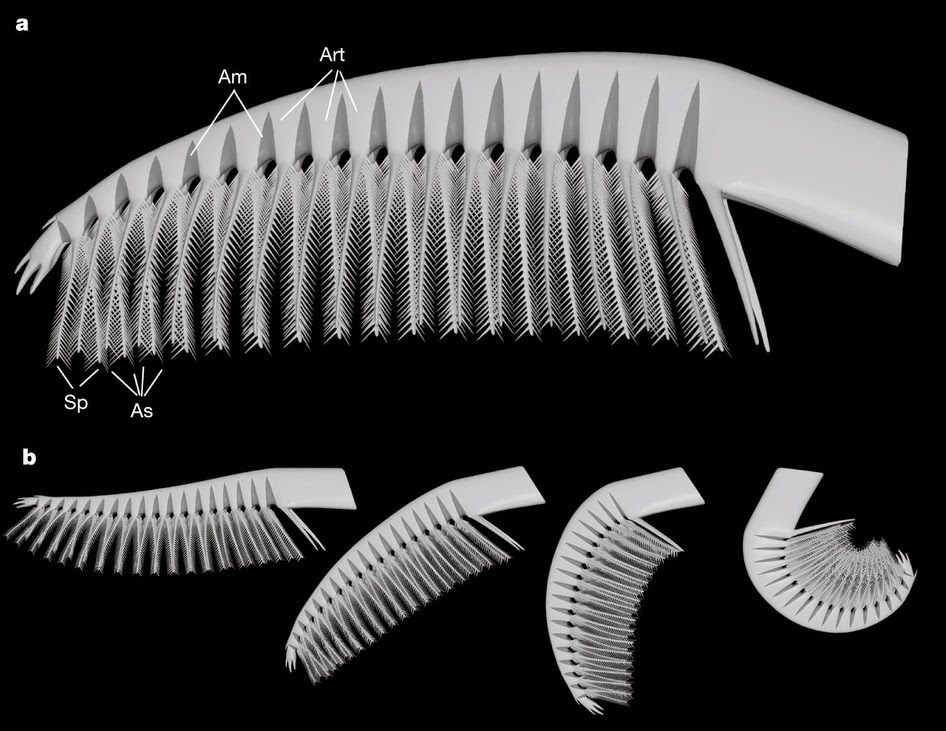
If that wasn’t enough to convince you that the Cambrian wasn’t an age of failed creatures, one recent discovery will. Tamisiocaris borealis is a newly-found anomalocarid, a relative of the famous Cambrian critter Anomalocaris, one of the world’s first large predators. The anomalocarids all feature “great appendages”* with adaptations which hint at a predator lifestyle, with small spikes and barbs perfect for grasping prey and articulating it into the ventrally-located mouth. What makes Tamisiocaris so special is that, instead of having great appendages for grasping prey, it evolved long, feather-like branches: Tamisiocaris was a filter-feeder.
The great appendage of Tamisiocaris. From Vinter et. al, 2014.

*Yes, this is the actual technical term.

That’s not such a stunning fact now: in the hundreds of millions of years since the Cambrian, filter-feeding has independently evolved across the animal kingdom, from whales to pterosaurs. But in the Cambrian, there was nothing that lived even a remotely close lifestyle. Tamisiocaris was the first creature we know of that evolved from its carnivorous, predatory ancestors to a lifestyle of peaceful planktivory. Instead of noshing on crunchy trilobites near the sea floor, it could glide along in the open ocean, using its huge brush-like great appendages to trap primitive plankton and other tasty vittles.

To me, this is the most exciting fossil found in recent years. Sure, reptiles will always have a special place in my heart, but when we find fossils from the Cambrian, especially ones which totally shake our idea of what it means to be ancient, and not primitive, we view our earth in a much more realistic, and much less mammalian-biased, light. 

Reconstruction of Tamisiocaris and other Cambrian critters by Rob Nicholls.

Tuesday, April 15, 2014

The Sorry-for-the-Absence Post

I can’t believe it’s been five months since I've written here. I kinda have a bad habit of falling in and out of projects… Allow me to try to fix this.

Anyway, lots has been happening in my life since I last wrote here. I’m finally starting to steer my life in the direction of actual biology, instead of slogging my way through classes. I will be heading to Ghost Ranch, New Mexico over the summer to work for a few weeks at the Hayden Quarry in the Chinle Formation, which is unbelievably exciting for me because of the formation's unique Triassic fauna (I’m particularly fond of weird little Vancleavea). I’ve been studying microfossils from the quarry with a professor here, and so far I've found some little bones and scales, which is more than I expected myself to find.

Just yesterday, my first-ever grant was accepted by the field station affiliated with my school. I will be monitoring temperatures in wood duck (Aix sponsa) nest boxes around the field station, as well as examining how temperature, humidity, direct sunlight, and habitat affect the colonization of these nest boxes by the ducks.

So, anyway, that’s what’s been going on with me. But I do hope to get back into writing for the blog. Lots of awesome zoological/paleontological happenings have been… Well, happening. Crocodylians turn out to climb trees more often than we imagine. A new Triassic marine reptile is the first tetrapod to display a “bony tube” of various types of ribs, presumably to protect itself from some of the first giant marine predators. Several new species of dinosaur have been named, including a new Portuguese species of Torvosaurus, the dwarf Arctic tyrannosaur Nanuqsaurus, and Anzu, which I will henceforth refer to as “Satan’s cassowary,” just to add to the list of terrifying (and terrible) bird-related monikers the species has acquired.


So, anyway, I apologize (for, what, the fourth or fifth time now) for the lack of updates. I’ll try my damnedest to keep this going.

Monday, November 25, 2013

Valuable lessons from gore-kings and thieves

Oh, yes. This pic again. Lythronax by Andrey Atuchin.
The Cretaceous was undoubtedly one of the most tumultuous times in earth’s history. Life was rapidly changing: over the course of eighty million years, the world saw a wave of never-before-seen groups of life, including flowering plants (and their accompanying pollinators), snakes, and “modern” birds. By the late Cretaceous, the world would have been alien to any animal living in the Jurassic. This was a world of giants, oddballs, tyrants, and tanks. The Cretaceous, despite being the last period of the Mesozoic, was the golden era for dinosaurs worldwide.

As the Cretaceous progressed from its vaguely Jurassic beginnings to its cataclysmic end, faunal groups the world over were surprisingly homogeneous. In North America and Asia, there was a relatively consistent fauna. Generally, the families that were present in such faunal group can be linked to Asian origins. It would make sense, then, that such species, over the course of tens of millions of years, migrated from their Asian motherlands to the brave new world of western North America. With each successive generations moving farther and farther across the land bridge connecting the two continents. However, two newly-described species contest this unidirectional migration. They seem to show that our understanding of late Cretaceous faunal shifts and the evolution of the families composing these faunal groups did not take straightforward paths to reach their eventual burial sites; rather, the migration between the two continents was much more complex.

A "tyrant map" from Wiki. Click to embiggen. The abundance of
tyrannosaurids in North America, and their lack in Asia, were thought
to represent the Asian origin of Tyrannosauridae.
The first recently-described species to raise intriguing questions about dinosaur biogeography and evolution is one that has been making the media rounds lately: Lythronax agrestes, the nowfamous “goreking of the southwest.” Apart from winning Most Badass Scientific Name of the Year, Lythronax reveals interesting aspects of tyrannosaurid evolution. It is the earliest known tyrannosaurid, dating back to about 80 million years, to a time when the North American dinosaur fauna was starting to take the form it would keep until the last day of the Mesozoic. Alongside Lythronax lived some of the first centrosaurine ceratopsians, which themselves would become major ecological players in a few more million years (more on that in an upcoming post), as well as hadrosaurine hadrosaurs. What makes Lythronax special is that it dispels the idea that tyrannosaurids first evolved in Asia. The earliest tyrannosauroids, as well as several species of advanced tyrannosaurids, have been found in China and Mongolia, leading to this logical conclusion. However, it appears that tyrannosaurids may have emerged in North America, evolving their characteristic juggernaut build and binocular vision there before migrating back to Asia. And, although only one Asian ceratopsid has been described thus far, it is likely that the centrosaurines with which Lythronax shared its environment travelled the same way, migrating north in giant herds to the floodplains of Canada and Alaska before returning to Asia.

Acheroraptor by Emily Willoughby. 
Another recently-described species has actually been known for quite a while, but has only recently been given a name. Acheroraptor temertyorum is a dromaeosaurid from Hell Creek, a formation bearing rocks from the end of the Cretaceous. The fauna of this formation is unmistakable, consisting of some of the most wellknown dinosaurs of all time. Tyrannosaurus was the apex predator, stalking lowland plains and forests populated with Triceratops, Ankylosaurus, and Edmontosaurus. For many years, it was labelled as a close relative of the Canadian Dromaeosaurus, a dromaeosaurine dromaeosaurid. Dromaeosaurines were North Americanan through and through, with no other species thus far discovered outside of the continent. It would make sense to assume that Acheroraptor shares a similar story, evolving from endemic early Cretaceous dromaeosaurines. However, Acheroraptor appears to have its roots not in North America, but yet another continent: it was not a dromaeosaurine, but a velociraptorine, an almost entirely Asian group. Even at the very end of the Cretaceous, species were still migrating between the continents of the northern hemisphere.

The relationship between where a species is found and where it comes from are not as straightforward as they may seem. Evolution is an enormous tale of unexpected outcomes and unlikely beginnings, as well as the forces which dictate such results. The wealth of fossil information we have found on ancient biogeography reveals a great deal of surprising new insight into the outward reasons for their long, successful time on this earth. 

Monday, November 18, 2013

Inside the mind of the hadrosaur

Hadrosaurids have been making headlines more often than usual in the past few weeks. Starting with the discovery of hadrosaur tails in both Alberta, Canada and Coahuila, Mexico, new discoveries of the dominant herbivores of the Cretaceous are popping up quite regularly. Since the two tails were uncovered, the youngest-known specimen of Parasaurolophus sp. was discovered and affectionately nicknamed “Joe.” Joe reveals much about lambeosaurine ontogeny in a tribe of lambeosaurines which are pretty poorly understood in terms of how ontogeny and gender affect the development of their signature tube-like crests (Farke et. al, 2013).
Amurosaurus riabinini. Reconstruction by Sergey Krasovskiy. 
Perhaps the most important news relating to hadrosaurs is the recent publication of cranial endocasts of the lambeosaurine Amurosaurus riabinini of Russia. These endocasts allow paleontologists to examine the structure of the brain’s outermost regions, allowing conclusions to be drawn my correlating the size of a given region to its importance to the animal. This, subsequently, allows us to speculate further on the behavior of these animals.

It has been theorized that the volume of the dinosaurian brain took up about half of the available space within the braincase. The recovered Amurosaurus, however, reveals that its brain took up around 60% of the braincase. Being an herbivorous reptile, this does not indicate a significantly higher level of intelligence than any standard reptile; however, this larger brain does indicate that, despite being huge, stolid animals, hadrosaurs were not dull.

Not only were they not dull, but compared to other herbivorous dinosaurs, hadrosaurids had among the highest brain-to-body ratios! The Amurosaurus brain reveals that its Reptilian Encephalization Quotient (REQ), or the ratio of a reptile’s actual brain-to-body mass to its expected mass, was higher than those of ceratopsians and sauropods, but lower than those of even some of the earliest theropods. This latter discovery is not surprising, as the instincts and brainpower needed to hunt are far greater than those needed to graze or browse.

The cranial endocast of A. riabinini. Scale bar represents 2cm for A, B,
and C, and 10cm for D. From Lauters et. al, 2013.
What makes the brain of Amurosaurus particularly important, and what does this show us about hadrosaurs? The detail of the endocast reveals an interesting aspect  of hadrosaur brain physiology: the pituitary gland is enlarged, possibly explaining one part of just how hadrosaurs attained such massive sizes in a relatively short period of time. A hadrosaur could grow from a five-foot-long hatchling to a thirty-foot-long adult in just 12 years, reaching their maximum size in just half the time it took contemporary predators to reach adulthood. The astonishing growth rate of hadrosaurs is part of the reason they prevailed in the late Cretaceous; reaching sexual maturity at just three years old, hadrosaurs could produce many offspring while being too large for most predators to tackle. The larger-than-expected size of the lambeosaurine brain is consistent with the notion that hadrosaurs, in general, were animals with relatively complex social interactions (Lauters et. al, 2013). The need for intraspecies communication between herd members is essential for maintaining herd structure. An enlarged brain processes more auditory and visual signals around it, giving credence to the theory that the large and elaborate crests in lambeosaurines were used for communication as well as courtship displays.

It is a common misconception that dinosaurs were truly dumb animals. Compared to their body size, it is true, their brains are much smaller than a mammal of the same dimensions. However, this does not exclude them from having engaged in complex behaviors which are comparable to those of modern animals. We now know from cranial endocasts of serveral taxa spanning various families that dinosaurs, in general, were much more complex, active, and interesting than previously thought.

References

Sunday, November 17, 2013

What the extinction of the western black rhino should mean to you


Despite the recent increase in social media concerning the extinction of the western black rhinoceros Diceros bicornis longipes, the subspecies was actually declared extinct in 2011, and the last sighting of wild individuals all the way back in 2001. However, the lesson we can learn from the plight of the western black rhino, as well as all other subspecies and species of rhino, is an extremely important one.

The demise of the worldwide rhino population, regardless of range or species, is intrinsically tied to the use of the animal’s horns in traditional Chinese medicine (TCM). Although the TCM trade has largely diminished, with several bans restricting the import of rhinoceros products into Middle Eastern and Eastern Asian countries, poachers still manage toslaughter wild rhinos at an astonishing, not to mention growing, rate.

The situation of the rhino is the same the world over – although some species are more abundant than others, no species is truly common, and two of the six* living species are critically endangered: the Indonesian Javan rhinoceros Rhinoceros sondaicus sondaicus is limited to the last 50 or so members of its subspecies, and the Vietnamese Javan rhino R. s. annamiticus was declared extinct in 2011 as well. The next most common rhino species, the Sumatran Dicerorhinus sumatrensis, has a wild population of about 200 individuals.

*Although most resources cite five rhinoceros species (black, white, Sumatran, Javan, and Indian), the northern and southern subspecies of white rhinoceros Ceratotherium simum have been found to be two distinct species.

The sadness associated with the extinction of a species, especially ones which have such an important ecological role, as well as worldwide recognition and popular appeal, is a sadness largely associated with the regret of not saving a species which the opportunity is present. We, as a species, as doing a fair amount to save the world’s remaining rhinoceros populations, but we truly need to do more if we wish to truly save these animals. Of course, as any biologist will tell you,  there are a myriad of species out there which are much smaller or lesser known than any rhinoceros species and which require much more of our attention. But no species deserves to be loosed to the whims of extinction in a rapidly changing world.

The fate of rhinoceros populations worldwide lies in our hands.
When the first historical anthropogenic extinctions occurred, the very notion of extinction was an alien thought. The fact that an entire species could be wiped out was beyond comprehension in a world in which an almighty power had personally created each and every species. By the time scientific minds had pieced together why, for example, no one had seen a dodo in years, it was far too late to do anything about it. When concern began over the fate of the western black rhinoceros, it was likewise already too late. An aerial survey tallied just 10 remaining individuals in northern Cameroon, and the odds of those individuals finding one another and breeding the population back into health were infinitesimally small. It is frustrating to admit when something natural is beyond any help, but, with our potential and the resources available to us, this does not have to be the only option. We can still work to save the world’s rhino species, and if we are truly concerned for their well-being, there is nothing to stop us from protecting them.

The earth is a cruel place, and all species eventually go extinct. What separates us, now in the 21st century, from those Portuguese and Dutch explorers who killed and ate all that they discovered, is that we have the awareness and the power to change the destiny of another species. Now, more than ever, we need to realize this potential and be responsible for the planet we are dismantling. What happened to the western black rhino is a reason to pity, but more than anything it is a reason to take action.

To find out more about rhinoceros conservation and how we can all help, visit these pages:

John R. Platt wrote a very detailed synopsis of the history of the western black rhinoceros, including its extinction. Check it out here:

Sunday, October 20, 2013

Game of Bones: Erratum

Upon sharing yesterday's post to Facebook, Dr. Thomas Holtz mentioned something important which I completely didn't realize. Triceratops and Torosaurus were not just "floating heads." This is, of course, obviously true, but represents a side of the debate unexamined in Longrich & Field (2013). In order to truly determine whether the two warrant their own respective genera can only be determined once the postcranial elements of both are examined.

Tyrannosaurus asks Torosaurus if he is, after all, a valid genus. By the great Luis V. Rey.

This is tricky because, well, we don't really have too many postcranial Torosaurus fossils. That's why the study focused entirely on the skull. If more Torosaurus bodies were known, the debate would probably never have arisen; indeed, the fact that such few bodies are recovered is part of the mystery of the animal in the first place. But, as any paleontologist can tell you, fossilization relies on very precise conditions, and even though we know a huge amount about the world of the past, there is much that we will never know.

Let's hope one that one day the debate can really come to an end. As of right now, although it seems likely that Torosaurus is not Triceratops, and while the evidence is present, the case is not closed just yet.

Wednesday, October 16, 2013

In Montana, it rains sheep and cougars

Scenes of intense predatory action are commonplace in nature documentaries. The poise, grace, and stealth of apex predators is unparalleled, and we are all captivated by such incredible feats of athleticism in the natural world.

Well, even top predators manage to botch things once in a while.

In Glacier National Park, a photographer (anyone know who?) spotted two bodies lying on a closed road. Not human bodies, thankfully, but the bodies of a predator and its prey that both met their demise in the heat of pursuit. The bodies were of a Dall sheep Ovis dalli and a cougar (mountain lion, puma, panther, what-have-you) Puma concolor. 


Lying at the bottom of a sheer cliff, the bodies not only tell of an incredible and clearly lethal fall, but of just how hard the two animals fell. The sheath of the sheep's horn came clean off upon impact (seen above, left), and its hind right leg had a severe compound fracture.

Interestingly enough, it doesn't seem like the cat was too far off from getting a nice mutton meal before the two met their untimely departure: the cougar died with a tuft of the sheep's fur in its mouth!

In the wild, slight miscalculations of distance or steepness, bad weather, and plain old bad timing can lead to terrible consequences. No animal is perfect at what it does. There is no species which kills 100% of the prey it intends to, and many risk death in the pursuit of one meal. And this doesn't just apply to today's animals; we have many instances of accidental death in the fossil record as well. Perhaps, if the conditions were right, the sheep and the cougar would form a fossil just like this...

For more photos of this scene, click here. Some of the photos are pretty gruesome, so proceed at your own discretion.

Tuesday, October 15, 2013

Game of Bones: The true identities of America's last ceratopsians

While we can learn a lot from fossils, there is still much we cannot determine just by examining petrified bones, feathers, and other structures. For one, it is difficult to determine whether or not a specimen represents an already-known species or is an entirely new one. This phenomenon occurs more often than one would think, and many extinct genera have a score of junior synonyms which were once considered to be different species. These often turn out just to be juveniles of already-known species, or display some pathology which had rendered them to appear different from the rest of their kind.

Of course, all adult animals known from fossils had to start somewhere – obviously, we have fossils of various dinosaurs ranging in age from embryonic to adult-most forms. Our knowledge of the ontogeny of dinosaurs ranges from species to species – in the case of some, such as Allosaurus and Maiasaura, we have records of complete life histories. In other species, juveniles can often be reassigned as other species or genera simply due to a lack of information on the species as a whole.

The two three-horned titans in question: Triceratops (left) and Torosaurus (right). Illustration by Nicholas Longrich.

One such ontogenetic debate originated last year concerning one of America’s fossilized sweethearts – none other than the three-horned darling that is Triceratops. Fossilized remains of Triceratops are abundant in the American west and are known from young individuals to adults. However, Triceratops wasn’t the only three-horned beast roaming North America at the end of the Cretaceous. Torosaurus,  a closely-related chasmosaurine, has been found alongside Triceratops from Colorado to Montana. However, unlike the remarkably complete life history we have of Triceratops, Torosaurusfossils are largely adult specimens.

Triceratops growth series by Gregory S. Paul. The bottom-most skull, and those
at right, represent Torosaurus. This series represents the logic of Horner et. al (2010).

The absence of young Torosaurus in the fossil record led Jack Horner et. al (2010) to believe that Torosaurus is not its own species, rather it represents the most mature specimens of Triceratops. It makes sense at first: we know animals get larger and, in some cases, more impressive as they age, and Torosaurus’ massive head and elongated frill are much more spectacular than the shorter, square frill of Triceratops. However, size and exaggeration of features do not necessarily contribute to the maturity of any given specimen, and this determination is even harder to make when all we have to work with are fossils.

When news broke that the world may lose Triceratops to cladistic lumping, a panic spread: what would we do without everyone’s favorite three-horn? How would museums cope with the innumerable info-graphics which would need to be reprinted? And the children… How would our children grow up in a world in which Triceratops was no longer a valid genus?

Thankfully, there is no need to worry. First of all, Triceratops was named in 1889, whereas Torosaurus was named in 1891, giving our herbivorous hero precedent over the long-frilled foe. Second of all, a paper has finally been published which puts this whole debate to rest. Well-known specimens of both genera were compared and analyzed, put through a gauntlet of 24 visibly-testable features which diagnose the chasmosaurines as juveniles or more mature specimens.

Testing such features as the curvature of the postorbital horns, the degree of scalloping of the parietals (bumps around the edge of the frill) and squamosals (pointed cheek bones), and the fusion of major bones of the skull allowed Nicholas Longrich and Daniel Field (2013) to put an end to this long-winded argument.  A total of 36 specimens from both genera were analyzed for the test.

Comparative ages and diagnostic features of the ontogenetic stages of Triceratops and Torosaurus. From
Longrich & Field, 2013.

When Horner cited Torosaurus as being just a mature Triceratops, he cited the fact that no juvenile specimens of the former have been discovered, whereas many young Triceratops have been discovered. Longrich and Field discovered that, while the overwhelming majority of Torosaurus specimens are, in fact, adults, at least one specimen represents a slightly younger animal, which instantly puts a hole in Horner’s logic. If young Torosaurus did exist, displaying ontogenetic characteristics diagnostic of a young animal far different from adult Triceratops, then it is impossible for the latter to be a “stepping stone” to the former. So, in your FACE, Horner! Torosaurus juveniles DO exist! Which means…

"And you read this in my voice!"

But, in all seriousness, both genera are valid. While they are both extremely similar in body-shape and lifestyle, they represent two different animals. And I’m sure Tyrannosaurus thought they tasted the same anyway.

A similar story of mistaken identity occurred between these three sympatric pachycephalosaurs. From left
to right, the specimens range from young to old.

Horner has proposed this lumping before with other species; coincidentally (or not), they all hail from about the same time and place. Besides Triceratops/Torosaurus, he is a strong proponent of Nanotyrannus representing a juvenile Tyrannosaurus, which has also recently been tested and supported. More closely related to the horned creatures in question, he has also suggested that the pachycephalosaurids Dracorex, Stygimoloch, and Pachycephalosaurus also represent three ontogenetic stages in the life of the lattermost species. I’m a bit hesitant to accept that Stygimoloch represents an intermediate between the other two, partially because I grew up with ol’ Styg as one of my favorite dinosaurs. Plus, the name is just awesome: Stygimoloch translates to “devil of the River Styx.”

I think we can all rest a bit easier tonight knowing that Longrich and Field have put an end to the attempted assassination of Triceratops as a genus. I know I can, anyway. 

Tuesday, October 1, 2013

Turn To Stone (on Lake Natron)

Lake Natron, in northern Tanzania, is an alkaline lake whose water has the pH of household ammonia. The water temperature can reach well above 100 degrees Fahrenheit, and supports only those species which are evolved enough to handle such a deadly environment. If there was ever a little slice of Hell on Earth, Lake Natron would be a contender.

A calcified African fish eagle Haliaeetus vocifer perches
above deadly Lake Natron. Photograph by Nick Brandt.

The water is so deadly to those not used to it that anything that merely touches it is calcified. Photographer Nick Brandt captured several spectacular shots of several calcified creatures who fell victim to the illusion of a crystalline, placid lake, only to emerge from the water and become preserved in stone.

A whydah Vidula sp.

When islands form on the caustic lake, they attract scores of both lesser and greater flamingos. The flamingos take advantage of the disappearing islands, constructing their mud-tower nests and breeding, all the while feeding on invertebrates in the more saline areas of the lake. However, like bathers on a shark-infested beach, even these seasonal visitors sometimes fall victim to the deadly water.

Even seasonal visitors, such as this lesser flamingo Phoenicopterus minor, still fall victim to the caustic water. Photograph by Nick Brandt.

Sunday, September 29, 2013

The Time of Great Weirdening

The Miocene (~23-5 Ma) was a tremendously eventful period in Earth's history. With non-avian dinosaurs long gone, the Age of Mammals was coming to its climax, with mammalian diversity reaching unprecedented levels which remain unmatched to this day. It seemed as though evolution had let go of the reigns of normality, and species, regardless of class, reached sizes unheard of or filling impossible niches. Each continent, and every sea, had its share of brand new weirdo denizens.

These bizarre new creatures didn't appear out of nowhere. Global cooling was causing a drastic change in the world's ecosystems. The land was becoming drier, the seas becoming cooler and more fertile. The Miocene marked the end of the era of primeval forests and swamps the size of continents, and slowly the post-dinosaurian world was fading into the past. Mammals were reaching the peak of their diversity. Many modern families of birds came into existence. The tremendous boas, crocodiles, and turtles were becoming more and more rare, their lineage surviving in a few sole species in the wetlands of South America.

Just as the puzzling world of the Paleogene was slipping into the past, the modern world was coming into view. Recognizable horses, rhinoceroses, elephants, antelope, whales, and many other families made their debut. The great apes were coming into fruition, and in a few tens of millions of years their descendants would becoming mankind.  However, the variety of species, even of recognizable ones, was far greater than any period of the Cenozoic, and has never been matched. In this post, I hope to highlight for you some of the most fascinating and, of course, the weirdest of the great Miocene menagerie.

Rise of the Planet of the Artiodactyls
With the disappearance of the rainforests in North America, a whole new environment was created. It may come as a surprise that, up until approximately 20Ma, grasses were rare if not completely absent from major environments. Now that large swathes of land were clear of overgrowth, vast prairies and savannahs began to form. It was on these savannahs that herbivorous mammalian diversity began to skyrocket, and artiodactyls, the even-hoofed mammals, had their first moment of glory.

For tens of millions of years, from the end-Cretaceous extinction until the rise of the grasslands, the majority of herbivorous mammals were perissodactyls, the family of mammals which includes horses, rhinoceroses, and tapirs. Their success was due, in part, to the fact that their simpler stomachs were more suited to digest nutritious plants of the understory. With rainforests so widespread, they found their niche as ground-level browsers. Slowly, artiodactyls were replacing even the largest perissodactyls; in China, the last of the indricotheres, the largest mammals to ever walk the earth, lived alongside some of the first giraffes. While perissodactyls were still commonplace on most plains, they became far outnumbered by strange artiodactyls.

A glimpse at life from the late Miocene of North America, by Jay Matternes. While rhinoceroses and horses were still common, they were outnumbered by camels, pigs, and other artiodactyls.
Grass is low in nutrients and requires a complex multi-chambered stomach to fully reap its benefits. Artiodactyls were already well-equipped - with three to four stomachs, depending on the family, they were quick to radiate onto the prairies and begin grazing. All over the world, brand new families of mammals were springing up - giraffes, true antelope, cattle, and hippopotami were widespread from mainland Europe and Africa all the way to eastern China. Camels, pigs, and pronghorns filled virtually every herbivorous niche in North America.

Some artiodactyls even became some of the most fearsome predators to roam the American plains. The entelodont Daeodon was as tall as a man at the shoulders and twice as long as a man's height, and was the veritable tyrannosaur of the Miocene. It was far larger than any other mammalian carnivore of its environment, and its power and jaws would have scared any other predator from its kill in an instant.

The terrible pig Daeodon approaching the carcass of the rhinoceros Teleoceras on the plains of North America. The artist Chavez describes Daeodon was "the T. rex of the Miocene."

In a few million years, grasslands the world over were populated by a myriad of never-before-seen grazers and browsers. Stephen Jay Gould's The Book of Life has an awesome two-page spread comparing Miocene North American and modern African mammals, and the similarity between the two faunas is incredible. However, the land wasn't the only place which was experiencing a faunal sea change.

The Endless Coast: Life in the oceans
The fertile oceans of the Miocene created an explosion in the abundance of large marine life. Not since the late Cretaceous, when seas were full of serpents, had the oceans seen such diversity and size. Cetaceans, pinnipeds, seabirds, and sharks were all at the peak of their diversity, most inhabiting the tremendous proto-Pacific Ocean. In those days, the Bering Sea had not yet opened up, and an expansive land bridge still connected Siberia to Alaska.

The physeteroid Zygophyseter, a whale not as large as sperm whales
today but just as intimidating.
All along this endless coastline, marine life flourished. The first recognizable dolphins, baleen whales, belugas, and porpoises abounded. Physeteroid whales, represented today by the sperm whale, were the first cetaceans evolved to prey upon other cetaceans. With their huge, pointed teeth, they were the orcas of their day. In recent years, the discovery of the enormous physeteroid Livyatan revealed just how large these predators could be - the size of a modern sperm whale, Livyatan (formerly Leviathan) sported both top and bottom teeth which were so large they have previously been mistaken for the tusks of mastodons. These carnivores likely specialized in feeding on smaller baleen whales, as well as smaller cetaceans and sharks. Strange rhabdosteid whales, like giant river dolphins, also patrolled the waters, feeding on small fish and cephalopods. Whales would never again be so diverse, though their prominent role in marine ecology would remain.

The four-tusked walrus Gomphotaria pugnax (top)
alongside other Miocene pinnipeds and flightless
auks on the ancient Californian coast. Reconstruction
by avancna on deviantArt.
Pinnipeds, including seals, sea lions, and walruses, were also incredibly diverse. A variety of predatory pinnipeds evolved to feed on the abundance of flesh in the water. Many evolved stranger dentition than any pinniped seen today; the walrus-relative Pelagiarctos (literally, "sea bear") sported sharp canines ideal for hunting smaller seals. Another relative, Gomphotaria, sported two pairs of tusks, blunter and shorter than the modern walrus's, ideal for rooting up and smashing shellfish. All along the proto-Pacific coast, pinnipeds of all sizes and relations were common. Some reached sizes comparable to those of modern elephant seals, making them the largest seals to ever swim.


A few coastal mammals during the Miocene were some of the strangest to ever live. From Baja California to Japan, one group of tubby mammals stood out from all the rest: the bizarre desmostylians. These mammals are closely related to both sirenians, including dugongs and manatees, as well as proboscideans such as elephants. However, their affinity with these groups, beyond the fact that there is some affinity, is largely unknown. The desmostylians were a chimera of oddities, sort of like a hippopotamus with a strunken head and giant, paddle-like feet. They were herbivorous, filling niches that sirenians would have in more tropical waters; the coldness of their environment allowed them to exploit such a niche. The desmostylians were a relatively short-lived group, evolving in the late Oligocene, just before the Miocene, and lasting to the end of the next period. They have no living relations beyond questionably related elephants and manatees.

Skeletal reconstruction and life restoration of the bizarre aquatic
mammal Paleoparadoxia. Life restoration by Roman Uchytel.

While marine life was strange throughout the world, the shores of one continent held perhaps the most bizarre and unlikely of all coastal creatures. This island continent was a land seemingly lost in time, still ruled by tremendous reptiles, towering rodents, birds that could run down and kill horses, and vultures the size of airplanes.

The Real Lost World
South America has always been a land of the strange, largely due to the fact that, up until a couple million years ago, it was still an island continent. Since the Mesozoic, it had been separated from all other continents, and thus South American fauna evolved independently of all other life on earth. The huge equatorial continent was a labyrinth of forests and swamps, and had any man set foot on such a land, they would have surely though they had stumbled into a nightmare.

A bit south of the endless coastline from southern California to southeastern Asia, the diversity and weirdness of the proto-Pacific did not stop in South America. The Peruvian coast has provided exquisite fossils representing a Galapagos-like environment chock full of seabirds, including several species of giant penguin, boobies (teehee), gannets, and saw-toothed pelicans. But beyond the myriad of bird species, one mammal ventured where none of its kind had been before: for a brief moment in time, sloths became ocean explorers.

The sea-sloth Thalassocnus. Reconstruction by Guillermo Navalon Fernandez. Alright, I'll admit, this represents the Pliocene Pisco Formation, a few million years later, but it's the best reconstruction I could find.
That's right, there were once marine ground sloths. Thalassocnus was a large sloth which evolved in a very different direction of its giant cousins of the savannahs, for instead of browsing treetops, it was an able swimmer that grazed on sea grasses. The sea-sloths lived alongside the bizarre whales of the coastal proto-Pacific, and if they had ventured far enough out at sea, they would have likely fallen prey to physeteroids and sharks, including the mega-shark Carcharocles (/Carcharodon) megalodon, which swam just beyond the South American coastline.

The giant caiman Purussaurus, which shared its environment
with several other giant crocodilians.
Northern South America at the time was largely covered in wetlands, and these huge steamy areas of water and vegetation were the ideal environment for giant reptiles. Enormous crocodilians, including the giant caiman Purussaurus, the huge gharial Gryposuchus, and the huge filter-feeding croc Mourasuchus all lived alongside one another, each reaching lengths upwards of 10m. The combination of heat, humidity, and area all contributed to the continued reign of giant reptiles. These tremendous creatures shared their environment with a variety of other strange reptiles including the stupendous turtle Stupendemys, as well as the largest rodents to ever live. Some, like Phoberomys, the "fearsome mouse," reached lengths of 3m, and would have made ideal prey for the crocodilians of the area.

Perhaps even more bizarre, and a bit frightening, is the fact that South American crocodilians at the time were not restricted to the water. Like taking a glance back to the Mesozoic, big land-crocodiles were still terrorizing the land, preying upon large mammals both in the wetlands and on dry land. Sebecosuchians, like rauisuchians from the Triassic, searched for prey on long legs which held their bodies high above the ground for easy movement on land. The fact that such dinosaurian wildlife continued to exist in South America, long after the reign of reptiles had ended across the rest of the globe (except for Australia, where enormous monitor lizards were predators par none), is an eye-opening discovery, and holds testament to just how isolated the continent was from the rest of the planet.

"Return to the Triassic," an aptly-named reconstruction of Miocene Venezuela. The sebecid Langstonia attacks the giant tapir-like mammal Granastrapotherium. Reconstruction by Zimices, from deviantArt.
The Miocene was a time of strangeness in every aspect of life. The shift in climate left behind a primordial world of unrecognizable mammals and created the brave new world of modern life on Earth. Many species of the Miocene would have been fairly recognizable to those living today, as many of the families of animals found today had their origins during this time. Yet, in the first period of "modernity," life was still extremely foreign - life had not been this big, this diverse, and this weird since the time of the dinosaurs.